
Recom 6SR Filters



-
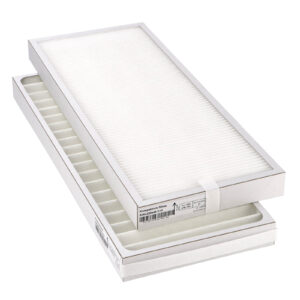 House brandExtract filter size: 536x220x40 mmSupply filter size: 536x220x40 mmFilter class (EN779): G4+F7Filter quantity in a set: 2 filtersProtection level
Filter protection level indicates efficiency in blocking particles or contaminants, varying by standard and application.
BasicGeneral dust and particle filtration
Pollen and moldCaptures pollen, mold spores, and other allergens
Smog and bacteriaProtects against allergens and urban pollution
1-1 of 1


Customer Reviews


Facebook review

Google review
Google review
Google review
Facebook review
Google review
Need Help? Start Here.
We’ve gathered answers to the most common questions about our products and services. If you can’t find an answer here, please contact us directly.
How do I find the right filter for my Recom heat recovery unit?


The simplest way is the model code on the front cover of the Recom unit, e.g. EPP3SE, 3S EPP or 3SR EC. This code tells you exactly which filter set fits your unit.
If the sticker has faded or become illegible over time, the filter can also be identified by simply measuring the current one – length, width and thickness in millimetres. You'll find both options, searching by model and by dimensions, in our catalogue's filters, so you can pick the right set even without knowing the exact model name.
What filter classes are used in Recom heat recovery units?
Unlike most other brands, which standardly use M5 class, Recom units are usually fitted with a G4 class filter – this catches larger particles (fluff, hair, coarser dust), and it's cheaper and quicker to replace. Some models also offer an F7 class filter on the supply air side – it captures finer particles and pollen.
G4 class is fine for basic protection, but for households with allergies it's worth considering an F7 set if your model supports it.
How often should Recom filters be replaced?
Since the standard G4 filter is a coarser class, it clogs faster than M5 or F7 class filters, so in Recom units it's recommended to check the filters every 2–3 months and replace them once you notice reduced airflow or increased noise. The standard maximum interval is 3–6 months, but in a dusty environment or near a busy street it's worth checking more often.
Regular checks protect not only air quality but also the recovery unit's own heat exchanger from premature contamination.
Is it worth choosing an equivalent filter instead of an original Recom one?
Yes – our equivalent Recom filters are made to the same dimensions and ISO 16890 filtration class (G4 or F7) as the original manufacturer's filters, only manufactured in the EU and at a lower price. Since G4 class filters need replacing more often than M5/F7, the price difference becomes significant over a year.
If you're unsure of the exact size, send us the model code or the filter's dimensions before ordering – we'll check the match in advance.
Can I use a higher-class F7 filter in a Recom unit instead of the standard G4?
In most cases yes, if your Recom model has a filter cassette designed for it – check whether the manufacturer offers an F7 variant for your specific model, since not all Recom series support this. An F7 filter captures finer particles and pollen better than a standard G4, but the higher density also means greater resistance to airflow.
Before switching class, it's worth making sure the fan can cope with the increased resistance without reducing airflow.
Still Have Questions?
Support details to capture customers that might be on the fence.
Contact Us Now
